All about Sheep Fencing
Electric fencing is a tried and tested way of keeping sheep where you want them. It works just as well for a small flock as it does for larger grazing areas. Electric sheep netting is one of the easiest options if you need a fence that can be moved around as grazing conditions change. It’s handy for creating temporary paddocks, dividing fields or moving sheep onto fresh pasture. For longer distances, wire is often a better option for a temporary fence. It puts less demand on the energiser, which gives you more flexibility when fencing larger areas. Looking for a permanent setup for your sheep? Below, we explain how to set up a permanent electric sheep fence.
Netting for sheep
Electric netting is popular because it is quick to set up, easy to move and requires no permanent fencing. The netting consists of horizontal strands with conductive wires that carry the electrical pulse, helping to create a clear boundary for your sheep. It is available in different heights and lengths, with integrated posts, making it easy to create an enclosure that suits the size and shape of your grazing area.
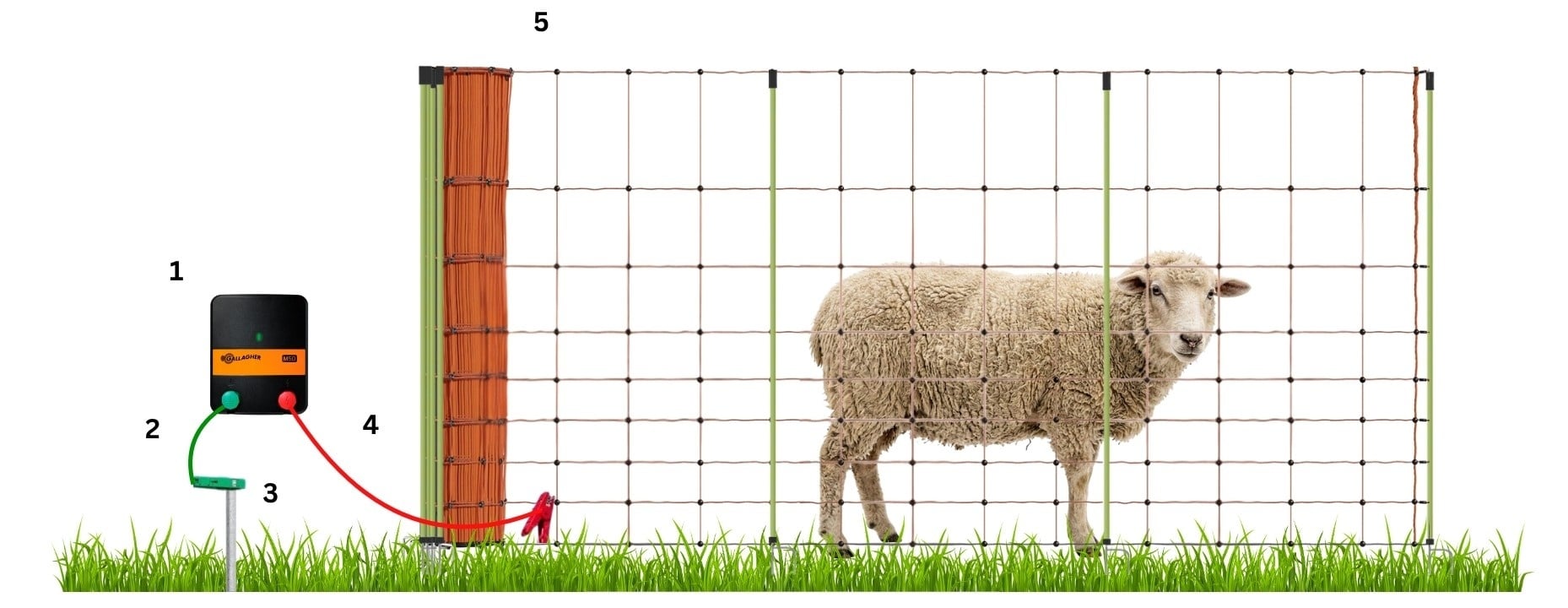
- A powerful mains or solar energiser is the most suitable choice. For example, the Gallagher M160 mains energiser can power up to 50 m of electric netting. for all energiser option have a look at Energisers suitable for netting
- Connect the green wire with the crocodile clip from the energiser to the earth stake
- Install the required number of earth stakes according to the specifications of your chosen energiser (keep earth stakes at least 3 m apart). You can find this information below this page or on the energiser’s product page
- connect the red connection cable with crocodile clip from the energiser to the net
- roll out the sheep netting and insert the posts in the ground in the desired shape
Permanent high tensile sheep fence
If your sheep are grazing the same fields year after year, a permanent electric fence can be a reliable and low-maintenance option. A few strands of electric wire or polywire on sturdy posts can create a solid boundary around your fields and paddocks. Once it’s installed, there’s no need to keep moving it, making it a good choice for regularly used grazing areas.
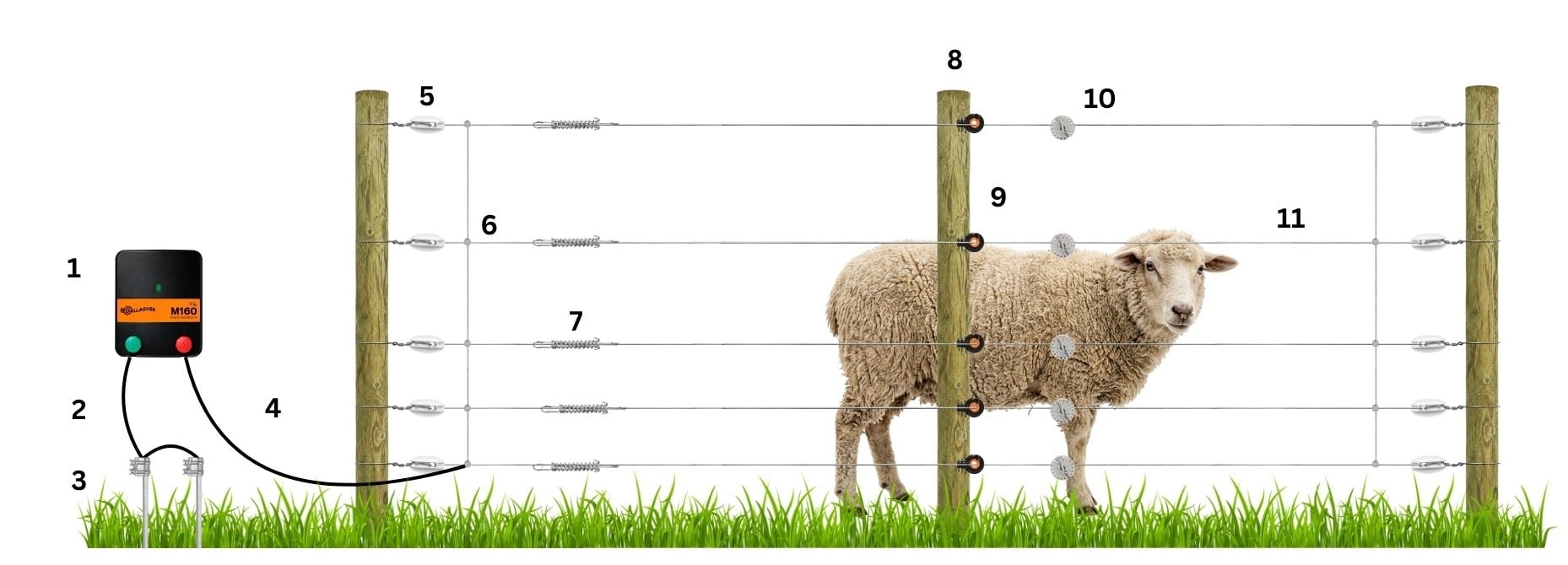
- For permanent as well as long fences a mains energiser is recommended to power your fence
- Lead out cables can be used to connect the energiser to a earth stake
- Earth stakes are required for grounding (check below this page or the energiser specs page for earth stakes per energiser)
- A lead out cable is connected to the energiser and directly to the fence (for easy attaching use a wire clip)
- Use a corner insulator at the start of each wire and at the end of each wire
- use a short piece of wire with connector clips to connect each fence wire, ensuring the electrical pulse is carried across all the wires
- for longer fences, we recommend using tension springs to help absorb the stretching and contraction of high-tensile wire, keeping the fence under tension
- Use sturdy wooden posts to create a long lasting fence (for instance insultimber posts)
- Screw ring insulators into the wooden posts and run the metal wire through them
- These wire tensioners make it easy to tension metal wire to the desired level. Use a wire tensioning tool to tighten or loosen the wire as needed
- Use galvanised metal wire (also called high tensile wire), as it is durable, highly conductive and well suited to sheep fencing
Mobile sheep fence
Temporary electric fencing is ideal when you need to change where your sheep graze. It’s easy to move around the field and can be used to create smaller paddocks or give fresh pasture a rest. Polywire or rope on plastic posts can be very practical when you need to cover longer distances.
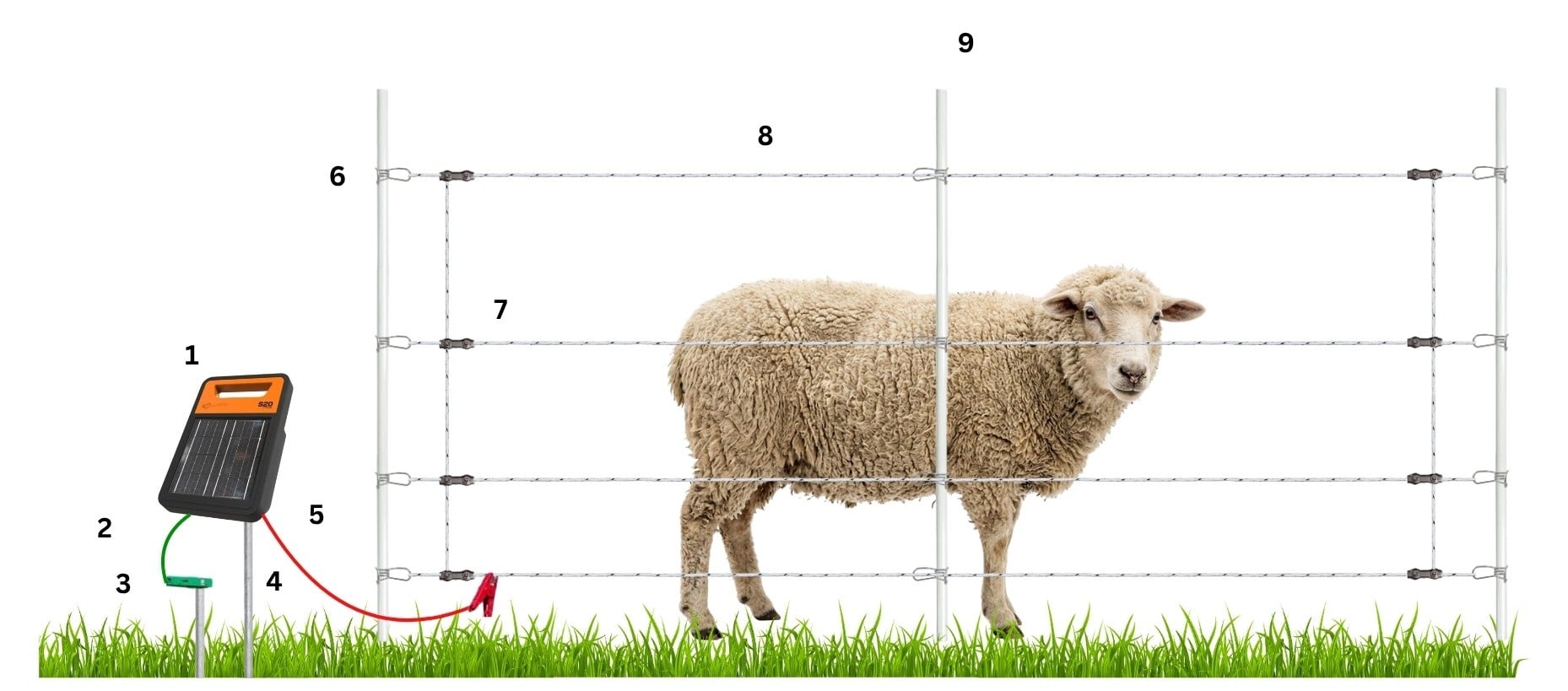
- A powerful solar energiser is recommended to provide reliable power wherever it’s needed.
- connect the green connection cable with crocodile clip from the energiser to the earth stake
- Install the required number of earth stakes according to the specifications of your chosen energiser (keep earth stakes at least 3 m apart). You can find this information below or on the energiser’s product page
- Earth stake + mounting adapter or energiser stand
- Red connection cable with crocodile clip connects the energiser to the fence wire
- clips for fibreglass posts are attached to the posts at the following heights: 15 cm, 30 cm, 40 cm, and 70 cm
- Polywire connectors can be used to create a small loop of the wire through the clips. connect all the wires together with a string of polywire
- A strong polywire works well for mobile sheep fencing, providing a lightweight and affordable fencing solution
- fibreglass posts are a good lightweight option, while plastic electric fence posts can also work well for this type of fencing
What energisers are suitable for sheep
Energiser |
Output voltage |
Max Multiwire fence distance |
Recommended Earth stakes |
Max Nets |
||
|
|
|
|||||
Mains |
|
|||||
|
|
Horizont Farming AN5000 |
10000 | 30 km | 3 x 1.7 m | 20 | |
|
|
Gallagher M5000i | 9000 | 26 km | 8 x 1.7 m | 30 | |
|
|
Gallagher MBS3000i | 7000 | 20 km | 7 x 1.7 m | 32 | |
|
|
Gallagher MBS2000i | 7000 | 17 km | 4 x 1.7 m | 24 | |
|
|
Gallagher MBS1000i | 8000 | 6 km | 4 x 1.7 m | 14 | |
|
|
Gallagher M1400 | 7700 | 14 km | 4 x 1.7 m | 15 | |
|
|
Gallagher M950 | 7700 | 11 km | 3 x 1.7 m | 12 | |
|
|
Gallagher M650 | 9200 | 10 km | 3 x 1.7 m | 9 | |
|
|
Gallagher M350 | 8700 | 7 km | 3 x 1.7 m | 6 | |
|
|
Gallagher MBS800 | 9200 | 10 km | 4 x 1.7 m | 10 | |
|
|
Gallagher MBS400 | 9100 | 8 km | 4 x 1 m | 6 | |
|
|
Gallagher MBS200 | 9000 | 5 km | 4 x 1 m | 3 | |
|
|
Gallagher MB300 | 9100 | 6 km | 4 x 1 m | 4 | |
|
|
Gallagher MB150 | 8500 | 4 km | 3 x 1 m | 1 | |
|
|
||||||
|
|
Battery |
|||||
|
|
Gallagher B300 | 10000 | 8 km | 4 x 1 m | 4 | |
|
|
Gallagher B200 | 9000 | 5 km | 3 x 1 m | 1 | |
|
|
Gallagher B100 | 10000 | 3 km | 2 x 1 m | 1 | |
|
|
Gallagher BA80 | 9400 | 3 km | 1 x 1 m | 1 | |
|
|
Hotline Raptor | 8600 | 18 km | 2 x 1 m | 15 | |
|
|
||||||
|
|
Solar |
|||||
|
|
Gallagher S400 | 9600 | 7 km | 4 x 1 m | 6 | |
|
|
Gallagher S200 | 9600 | 5 km | 2 x 1 m | 2 | |
|
|
Gallagher S60Li | 8900 | 2 km | 1 x 1 m | 1 | |
|
|
Hotline Fire Drake 67 |
11000 | 5 km | 1 x 1 m | 5 | |
| * |
We're here to help
We hope we’ve given you plenty of useful tips to get you started. If you’ve got any questions, feedback or just want to chat through the best fencing setup for sheep and lamb, we’re always happy to help. Drop us a line at [email protected], we’d love to hear from you!