All About Deer Fencing
If you’ve got deer regularly coming onto your land, you’ll know how much damage they can do. One night they can get into a field, garden or young woodland and make a real mess of things. They love eating crops, garden plants or young trees down to the ground. A well setup electric wire can be a good way of putting them off. Rather than building a tall, expensive deer fence, you can use electric fencing to create a barrier that encourages deer to keep their distance.
Our permanent deer fencing is ideal for areas that need long-term protection, while our mobile and temporary fencing is useful for seasonal protection or where the fence needs to be moved from one area to another.
Muntjac deer
We’re getting more and more enquiries about fencing for muntjac. Their population is growing across the UK, and they’re becoming an increasing problem for gardens, crops and young trees. If muntjac are starting to turn up regularly on your land, the right electric fencing can help keep them out.
Installing a Deer Fence
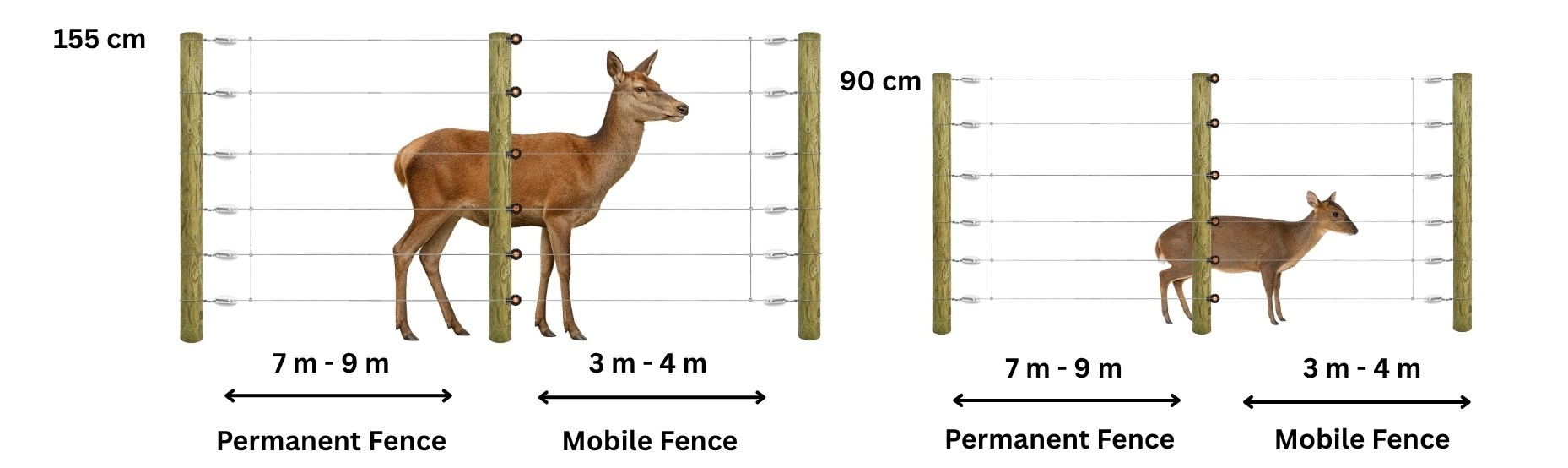
Mobile Electric Deer Fence
For a garden or orchard that needs protection for part of the year, a temporary fence can be a particularly handy option. You can put it up when the risk of damage is highest and take it down when it’s no longer needed. If you need year-round protection, a permanent fence is the better choice.
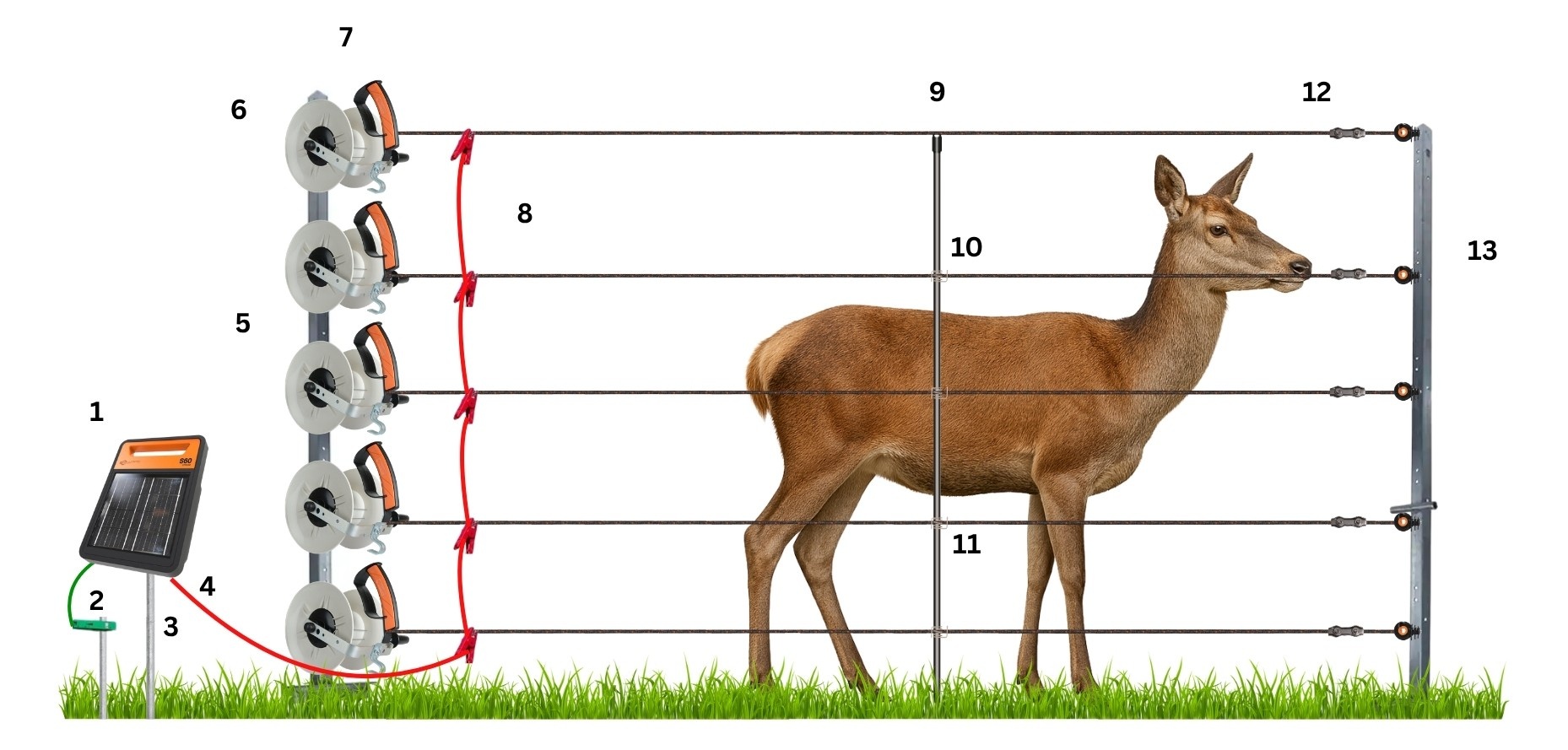
- A powerful solar energiser is recommended to provide reliable power wherever it’s needed.
- connect the green connection cable with crocodile clip from the energiser to the earth stake. Install the required number of earth stakes according to the specifications of your chosen energiser (keep earth stakes at least 3 m apart). You can find this information on the energiser’s product page.
- Earth stake + mounting adapter or energiser stand
- Red connection cable with crocodile clip connects the energiser to the fence wire
- We often recommend using a sturdy starting post like wooden or metal posts. Metal posts such as the Gallagher Multi-Reel Post is great as it allows up to five reels to be attached. This can be especially useful for longer fences, although it isn’t essential.
- We recommend fencing reels with rope or wire as a reliable and easy-to-use option for your deer fence. They’re particularly handy if you need to move or adjust the fence from time to time
- Use the reel brackets to attach the reels to the metal post. They’re easy to fit using the included nuts, bolts and wing nuts.
- Use Multi-Reel Connector Sets to connect all the wires together (you may need two sets depending on how many wires you aim to electrify). The crocodile clips attach to the wires and make it easy to connect them.
- We have a few options for intermediate posts, but one we can certainly recommend is our 2 m tall deer posts. They’re lightweight and easy to install, making them a practical choice for a deer fence
- Use a strong electric fence polywire or rope for the fence wires. For example, Vidoflex 9 TurboLine Polywire is a good option for a deer fence.
- These wire clips are compatible with the deer posts and can be easily attached at the recommended heights. You can also adjust them to suit your preferred wire spacing.
- Polywire connectors can be used to create a small loop in the wire and attach it securely to the ring insulator. Simply make a loop in the wire, fit the connector and attach it to the ring insulator.
- The same metal posts from start can be used to end the fence. Use bolt-on ring insulators, as they can easily we bolt on through the holes in the metal posts.
Permanent Electric Deer Fence
If deer are a regular problem, a permanent electric fence is a good option for year-round protection. A sturdy setup with wooden posts and multiple electric wires creates a reliable barrier around your garden, orchard or crops. Once installed, it stays in place and needs less moving and setting up than a temporary fence.
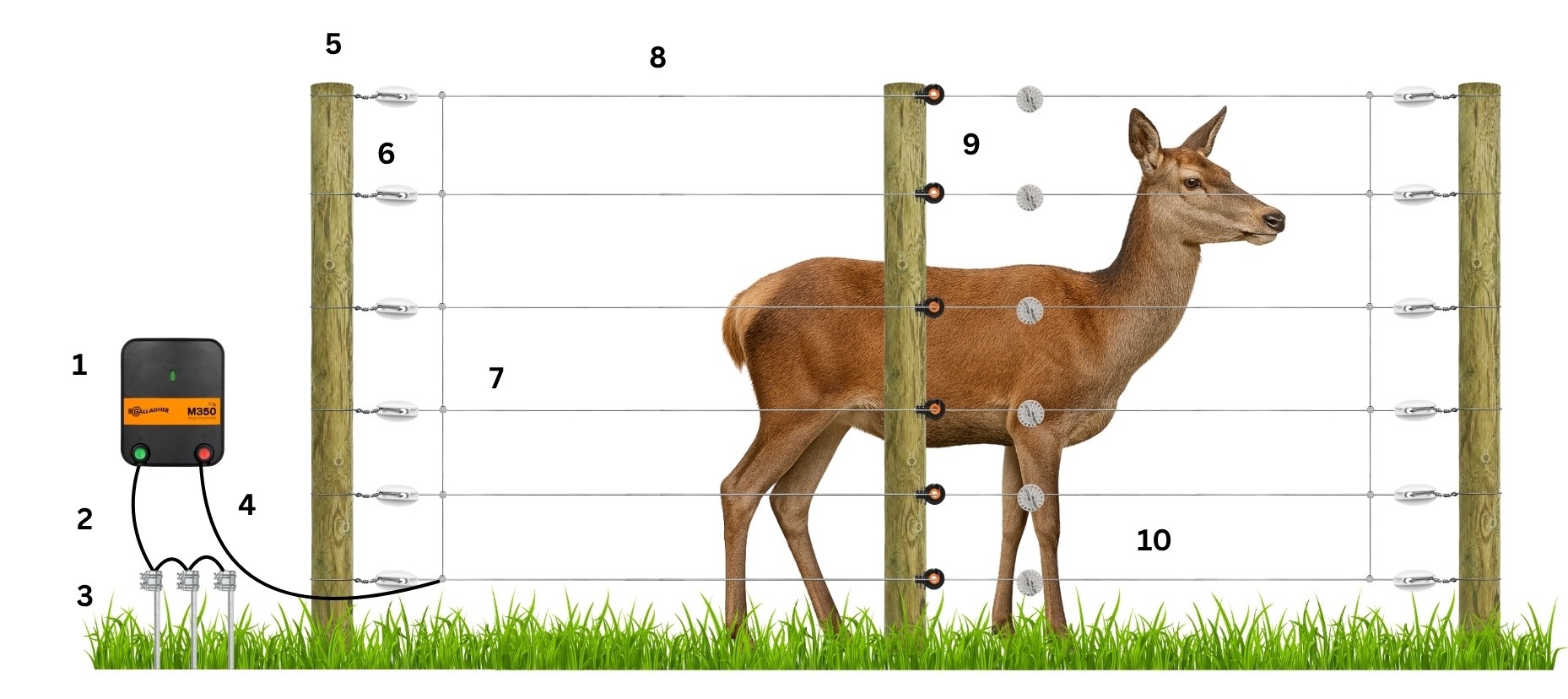
- A mains-powered energiser is well suited to powering a permanent deer fence with six wire lines. Mains energisers provide a consistent power supply and are a good choice when the fence is staying in place all year round.
- Connect a lead-out cable or crocodile-clip wire from the energiser to the earth stakes.
- Install the required number of earth stakes according to the specifications of your chosen energiser (keep earth stakes at least 3 m apart). You can find this information on the energiser’s product page
- Connect a lead-out cable or crocodile-clip wire from the energiser to the fence
- Tall wooden posts provide a strong and durable base for a long-lasting permanent deer fence. Make sure the posts are tall enough to provide sufficient height above the ground, with enough support to keep the fence secure and upright
- Use a corner insulator at the start of each wire and at the end of each wire
- use a short piece of wire with connector clips to connect each fence wire, ensuring the electrical pulse is carried across all the wires
- Use galvanised metal wire (also called high tensile wire), as it is durable, highly conductive and well suited to deer fencing
- Screw ring insulators into the wooden posts and run the metal wire through them
- These wire tensioners make it easy to tension metal wire to the desired level. Use a wire tensioning tool to tighten or loosen the wire as needed
What energisers are suitable
Energiser |
Output voltage |
Max Multiwire fence distance |
Recommended Earth stakes |
||
|
|
|
||||
Mains |
|
||||
|
|
M5000i | 9000 | 26 km | 8 x 1.7 m | |
|
|
MBS3000i | 7000 | 20 km | 7 x 1.7 m | |
|
|
MBS2000i | 7000 | 17 km | 4 x 1.7 m | |
|
|
MBS1000i |
8000 | 6 km | 4 x 1.7 m | |
|
|
M1400 |
7700 | 14 km | 4 x 1.7 m | |
|
|
M950 |
7700 | 11 km | 3 x 1.7 m | |
|
|
M650 | 9200 | 10 km | 3 x 1.7 m | |
|
|
M550 | 9200 | 9 km | 3 x 1.7 m | |
|
|
M350 | 8700 | 7 km | 3 x 1.7 m | |
|
|
MBS800 |
9200 | 10 km | 4 x 1.7 m | |
|
|
MBS400 | 9100 | 8 km | 4 x 1 m | |
|
|
MBS200 | 9000 | 5 km | 4 x 1 m | |
|
|
MB300 | 9100 | 6 km | 4 x 1 m | |
|
|
MB150 | 9100 | 6 km | 4 x 1 m | |
|
|
MB150 | 8500 | 4 km | 3 x 1 m | |
|
|
|
|
|||
|
|
Battery |
|
|||
|
|
B300 | 10000 | 8 km | 4 x 1 m | |
|
|
B200 | 9000 | 5 km | 3 x 1 m | |
|
|
B100 | 10000 | 3 km | 2 x 1 m | |
|
|
B60 | 8500 | 1 km | 1 x 1 m | |
|
|
BA80 | 9400 | 3 km | 1 x 1 m | |
|
|
|
|
|||
|
|
Solar |
|
|||
|
|
Hotline Fire Drake 200 |
11000 | 18 km | 3 x 1 m | |
|
|
S400 | 9600 | 7 km | 4 x 1 m | |
|
|
S200 | 9600 | 5 km | 2 x 1 m | |
|
|
S100 | 9600 | 3 km | 2 x 1 m | |
|
|
S60Li | 8900 | 2 km | 1 x 1 m | |
|
|
Gallagher S30Li | 9000 | 1.5 km | 1 x 1 m | |
| * |
We're here to help
We hope we’ve given you plenty of useful tips to get you started. If you’ve got any questions, feedback or just want to chat through the best fencing setup against deer and muntjac, we’re always happy to help. Drop us a line at [email protected], we’d love to hear from you!