All about Horse Fencing
Horses are naturally flighty animals and rely heavily on their eyesight. That’s why it’s important to choose fencing that suits their behaviour. For horses, highly visible fencing is generally the best choice. If a horse is startled or feels threatened, its natural instinct is to run. A well-designed electric fence can help reduce the risk of serious injury, as the horse is less likely to become caught up in the fence. By comparison, running into a barbed wire fence can result in serious injuries. Choosing the right fencing for horses is therefore essential for keeping them safely contained while reducing the risk of injury.
Installing a Horse Fence
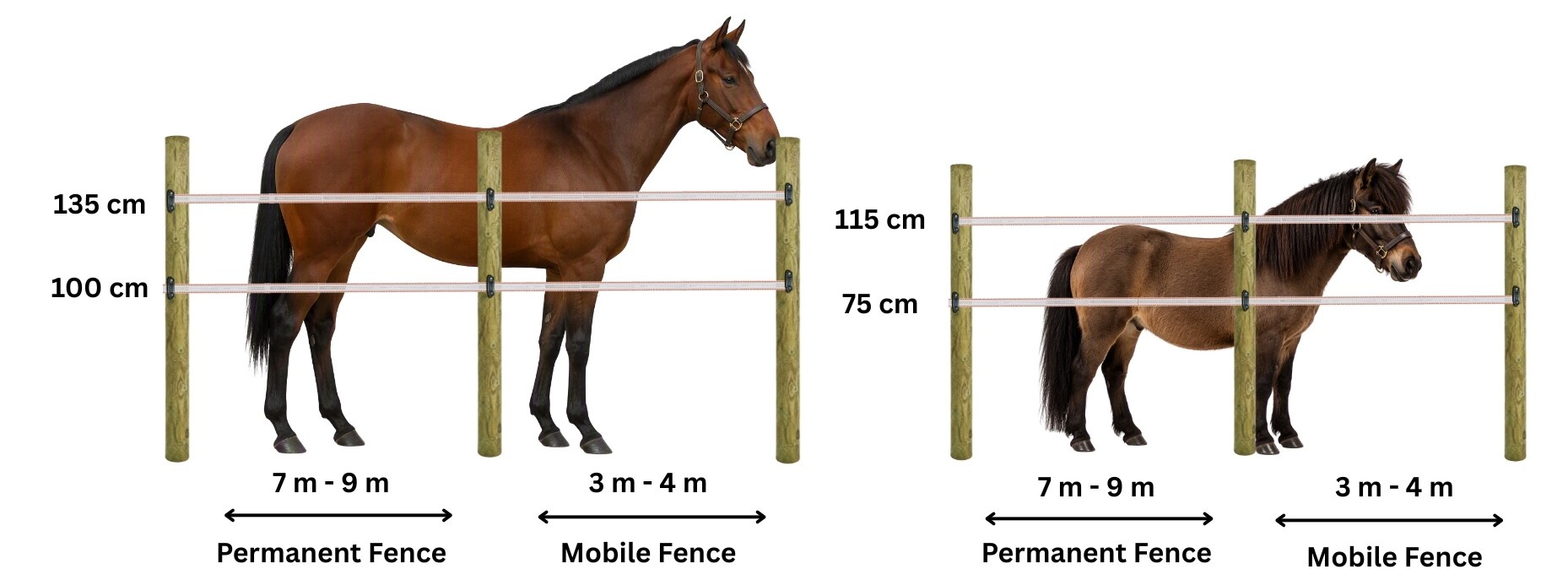
There are a few important things to consider when setting up a horse fence. The fence needs to be high enough to prevent horses from jumping over it, as horses are capable jumpers and can easily clear a low fence. The spacing between the posts is also important. If the posts are too far apart, the conductors can sag, making the fence less effective and potentially less safe. With a mobile or temporary fence, the posts are usually pushed less deeply into the ground than permanent posts. To keep the fence stable, the posts should therefore be positioned closer together, as shown in the photo above. In most cases, we find that two lines of electric tape are perfectly sufficient for fencing in horses, giving them a clear boundary.
Mobile electric horse fencing
Mobile horse fencing is a handy way to create temporary paddocks and corrals without the need for permanent fencing. It makes it easy to move horses onto fresh grazing, give parts of the field time to recover and keep grass intake under control. You can also use it for strip grazing or simply divide a larger field into smaller paddocks as and when you need to.
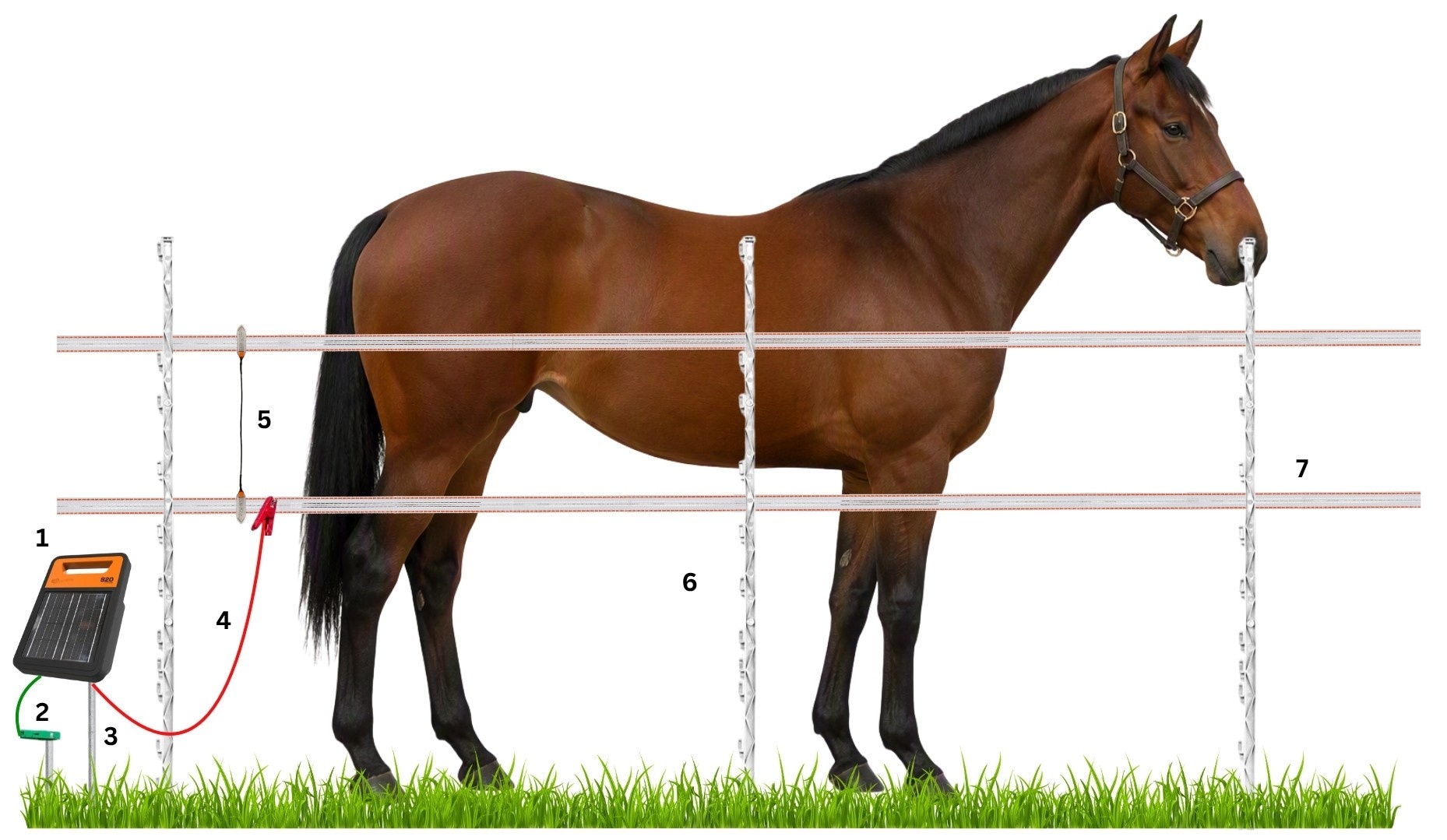
What you’ll need to build this fence:
- We generally recommend Solar energiser as the mobile power source of your fence
- Earth stake connects to the green connection cable with crocodile clip with the energiser
- Earth stake + mounting adapter or energiser stand
- Red connection cable with crocodile clip connects the energiser with the tape conductor
- A tape connector allows the current to flow through both fence tape lines. Simply connect the tape carrying the current to the second tape line. This creates a continuous electrical connection between both lines.
- We recommend Plastic fence posts (height up to 135 cm for horses and 115 cm for ponies) they’re lightweight, easy to move and won’t cost you a fortune
- Electric fence tape is ideal for horses due to its high visibility. 40 mm or 20 mm width are both suitable for temporary fencing
Permanent electric horse fencing
Permanent fencing is a good option if you want a more fixed setup for your horses. Wooden posts with electric fencing can be used to create clear boundaries around fields and paddocks, giving you a sturdy fence that stays in place year-round. It also works well if you have set grazing areas that you don’t need to move or change regularly. Of course, you can still divide permanent grazing areas into smaller sections using gates.
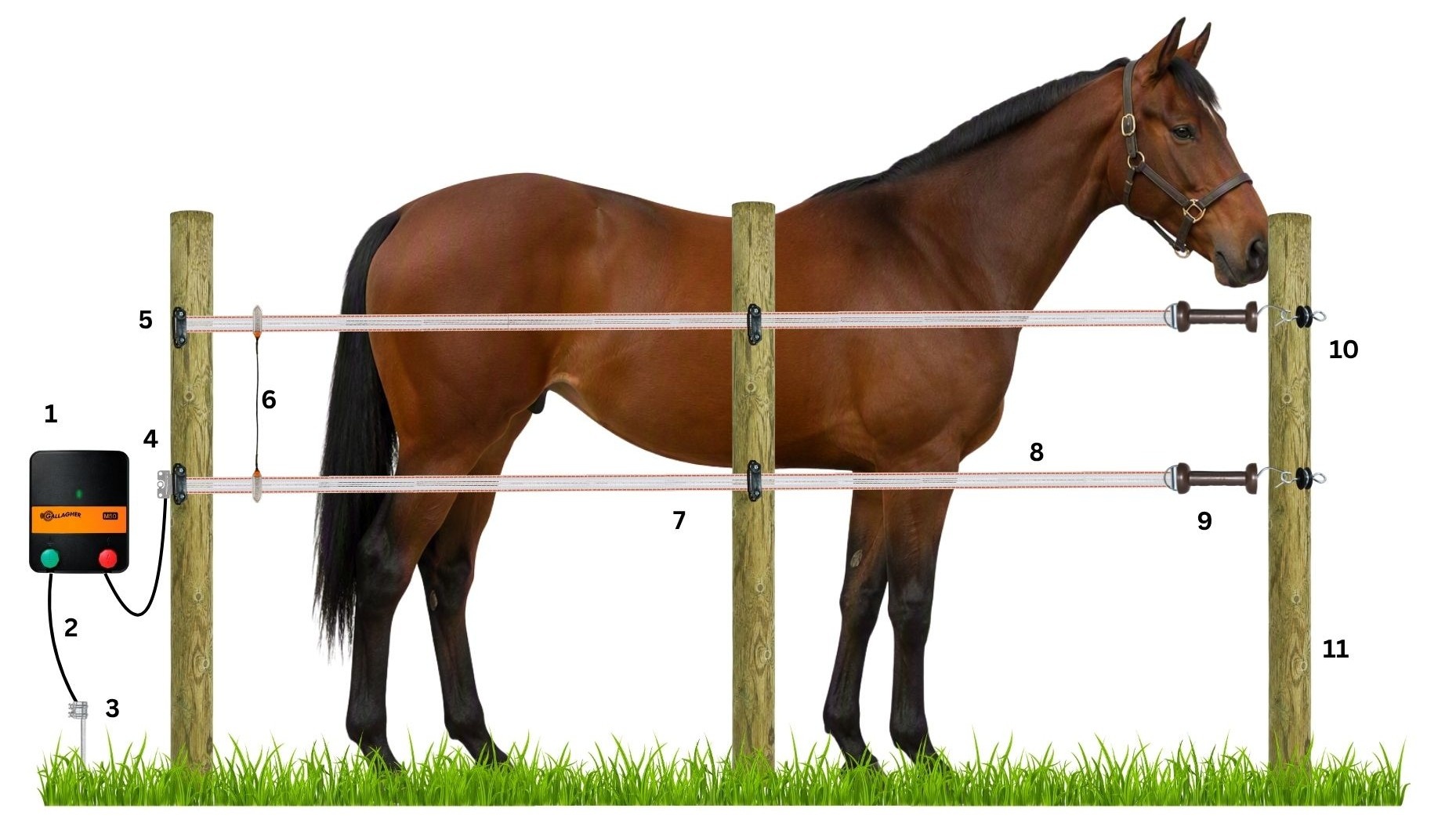
What you’ll need to build this fence:
- A mains-powered energiser is well suited to powering a permanent horse fence with two lines. Mains energisers provide a consistent power supply and are a good choice when the fence is staying in place all year round
- Lead out cables can be used to connect the energiser to an earth stake. A good earth connection is essential for your fence to work properly and deliver a strong shock
- Earth stakes are required for grounding (check the energiser specs page for earth stakes per energiser)
- A connection plate is attached to the tape insulator and connects through the lead out cable with the energiser. Another option is a tape connection cable between energiser and fence tape.
- Screw Horse tape insulators into the posts at recommended heights. We have a range of tape insulators available, so you can choose the option that best suits your fence
- A tape connector allows the current to flow through both fence tape lines. Simply connect the tape carrying the current to the second tape line. This creates a continuous electrical connection between both lines.
- tape insulators should be screwed into the intermediate wooden posts. They keep the fencing tape securely in place and help it stay taut along the fence line
- For permanent fencing, we recommend using 40 mm electric tape as this width is highly visible and durable for long term use
- tape gate handles create gate for your or your horses to pass through
- gate handle insulators can easily be screwed into the posts
- Use sturdy wooden posts to create a long lasting fence (for instance insultimber posts)
Energiser |
Output voltage |
Max Multiwire fence distance |
Recommended Earth stakes |
||
|
|
|
||||
Mains |
|
||||
|
|
Gallagher M5000i | 9000 | 26 km | 8 x 1.7 m | |
|
|
Gallagher MBS3000i | 7000 | 20 km | 7 x 1.7 m | |
|
|
Gallagher MBS2000i | 7000 | 17 km | 4 x 1.7 m | |
|
|
Gallagher MBS1000i | 8000 | 6 km | 4 x 1.7 m | |
|
|
Gallagher M1400 | 7700 | 14 km | 4 x 1.7 m | |
|
|
Gallagher M950 | 7700 | 11 km | 3 x 1.7 m | |
|
|
Gallagher M650 | 9200 | 10 km | 3 x 1.7 m | |
|
|
Gallagher M350 | 8700 | 7 km | 3 x 1.7 m | |
|
|
Gallagher M160 | 7700 | 2.5 km | 2 x 1 m | |
|
|
Gallagher M120 | 7000 | 2 km | 2 x 1 m | |
|
|
Gallagher MBS800 | 9200 | 10 km | 4 x 1.7 m | |
|
|
Gallagher MBS400 | 9100 | 8 km | 4 x 1 m | |
|
|
Gallagher MBS200 | 9000 | 5 km | 4 x 1 m | |
|
|
Gallagher MB300 | 9100 | 6 km | 4 x 1 m | |
|
|
Gallagher MB150 | 8500 | 4 km | 3 x 1 m | |
|
|
Hotline Gemini 80 | 8200 | 12 km | 2 x 1 m | |
|
|
Horizont Farming AN5000 | 10000 | 30 km | 3 × 1.7 m | |
|
|
Hotline Gemini 40 | 7500 | 8 km | 1 x 1 m | |
|
|
|||||
|
|
Battery |
||||
|
|
Gallagher B300 | 10000 | 8 km | 4 x 1 m | |
|
|
Gallagher B200 | 9000 | 5 km | 3 x 1 m | |
|
|
Gallagher B100 | 10000 | 3 km | 2 x 1 m | |
|
|
Gallagher B60 | 8500 | 1 km | 1 x 1 m | |
|
|
Gallagher BA80 | 9400 | 3 km | 1 x 1 m | |
|
|
Gallagher BA40 | 9400 | 1.5 km | 1 x 1 m | |
|
|
Gallagher BA30 | 9600 | 0.75 km | 1 x 1 m | |
|
|
Gallagher BA20 | 9600 | 0.5 km | 1 x 1 m | |
|
|
Gallagher B10 | 7900 | 0.5 km | 1 x 1 m | |
|
|
|||||
|
|
Solar |
||||
|
|
Gallagher S400 | 9600 | 7 km | 4 x 1 m | |
|
|
Gallagher S200 | 9600 | 5 km | 2 x 1 m | |
|
|
Gallagher S120Li | 10000 | 4 km | 2 x 1 m | |
|
|
Gallagher S60Li | 8900 | 2 km | 1 x 1 m | |
|
|
Gallagher S30Li | 9000 | 1.5 km | 1 x 1 m | |
|
|
Gallagher S20Li | 8900 | 1 km | 1 x 1 m | |
|
|
Gallagher S16Li | 8000 | 0.5 km | 1 x 1 m | |
|
|
Gallagher S12 | 9200 | 0.4 km | 1 x 1 m | |
|
|
Horizont Ranger | 10600 | 10 km | 2 x 1 m | |
| * |
We're here to help
We hope we’ve given you plenty of useful tips to get you started. If you’ve got any questions, feedback or just want to chat through the best fencing setup for your horses or ponies, we’re always happy to help. Drop us a line at [email protected], we’d love to hear from you!